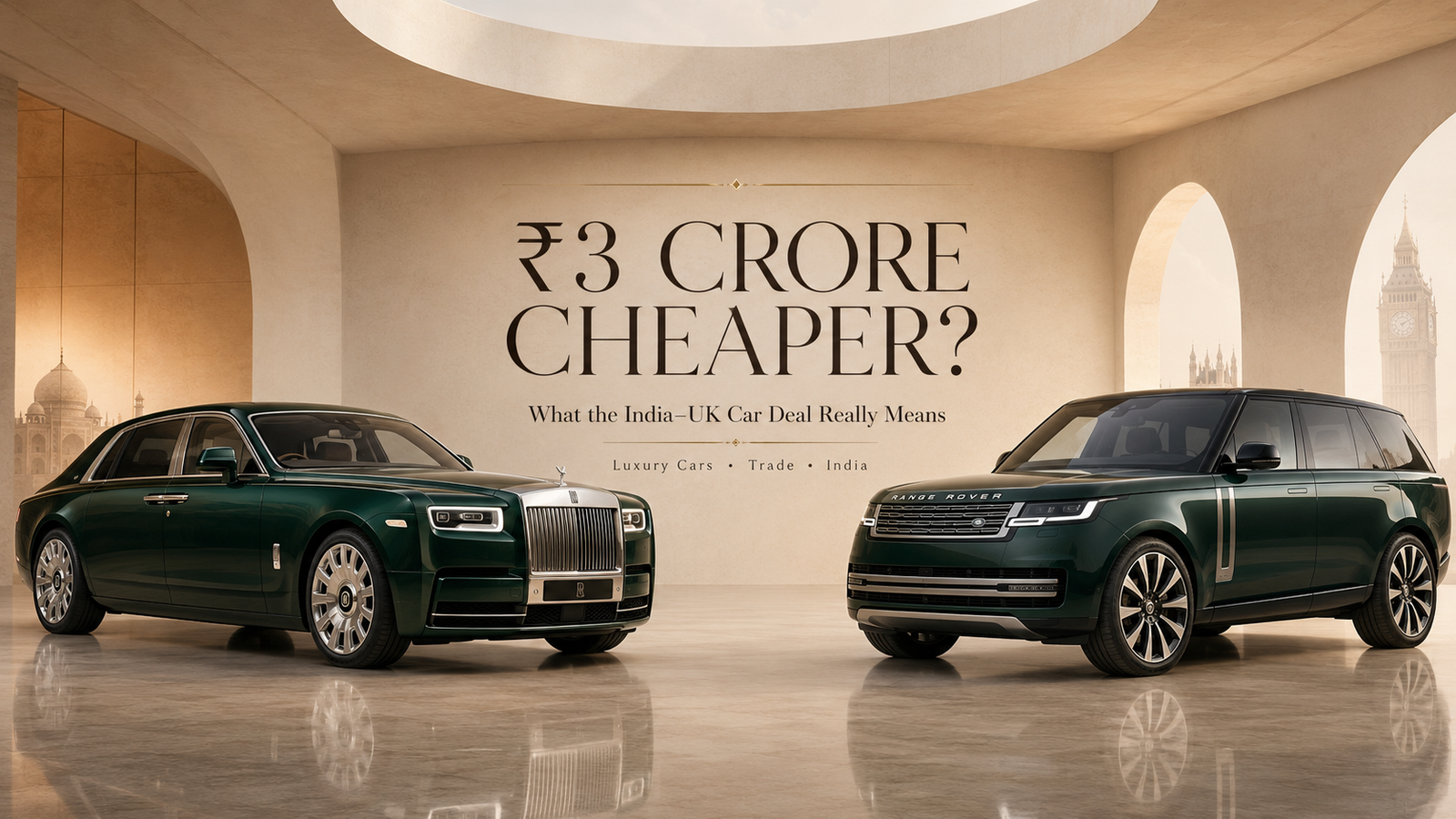
The Truth Behind the India–UK Car Deal
Imagine walking into a luxury-car showroom and discovering that the car you admired last month could potentially cost significantly less—not because of a new model, discount or festive offer, but because two countries signed a trade agreement.
That possibility has now become one of the biggest conversations in India’s luxury-car industry.
On July 15, 2026, the India–UK Comprehensive Economic and Trade Agreement officially came into force. Among its most discussed provisions is the reduction in import duties on qualifying British-made automobiles entering India. already suggesting that certain Rolls-Royce, Range Rover, Aston Martin and McLaren models could become cheaper by ₹1–3 crore.
But will that actually happen?
The real answer is more interesting than the headline.
What Has Actually Changed?
Before the agreement, fully imported vehicles entering India could attract customs duties as high as approximately 110%.
Under the new arrangement, tariffs on qualifying UK-manufactured internal-combustion vehicles will initially fall to approximately 30–50% within a quota-based system. The agreement provides for tariffs to eventually fall as low as 10% for eligible vehicles. te quota begins at approximately 20,000 vehicles in the first year and is scheduled to increase to around 37,000 vehicles by the fifth year. or structural change.
However, it does not mean every British luxury car will immediately become dramatically cheaper.
Why the ₹3 Crore Price Cut Is Not Guaranteed
Import duty is only one part of a luxury car’s final price in India.
The retail price can also include:
- GST and compensation cess
- Shipping and insurance
- Homologation and certification costs
- Currency fluctuations
- Distributor and dealership margins
- Manufacturer pricing strategy
- Optional equipment and personalisation
Manufacturers may pass on the complete tariff benefit, retain part of it, reposition certain models or use the savings to introduce better-equipped variants.
Therefore, a reduction in customs duty does not automatically translate into an identical reduction in the ex-showroom price.
Reports suggesting savings of ₹1–3 crore may be possible on certain extremely expensive, fully imported vehicles, but buyers should wait for official model-wise price announcements. Could Benefit?
The biggest potential beneficiaries are qualifying UK-built internal-combustion vehicles imported into India as completely built units.
This could include selected models from brands such as:
- Rolls-Royce
- Bentley
- Aston Martin
- McLaren
- Range Rover and Land Rover
However, three questions will matter for every model:
Where was the vehicle manufactured?
A British badge does not automatically confirm that every model qualifies as UK-origin.
Is the vehicle locally assembled in India?
Several luxury vehicles are already assembled locally using imported components. Their pricing structure is different from that of fully imported cars.
Does the importer receive access to the tariff quota?
The reduced duty operates through an approved quota and eligibility framework. It is not an unlimited concession available automatically on every imported vehicle. British Electric Cars?
This is where many early reports may confuse buyers.
The immediate concessions primarily favour qualifying internal-combustion vehicles. Separate quota access for British electric, hybrid and hydrogen passenger vehicles is scheduled to begin later, from the sixth year of the agreement.
That means buyers should not assume that every British electric luxury car will receive the same immediate price advantage. Impact Could Be on Pre-Owned Luxury Cars
The most fascinating part of this agreement may not be what happens inside new-car showrooms.
It may be what happens to existing luxury cars.
When the official price of a new vehicle changes significantly, the market value of pre-owned examples can also be affected. Buyers begin comparing a two-year-old vehicle with the revised price of a brand-new one.
This could place pressure on the resale values of certain fully imported models purchased before the tariff reduction.
At the same time, lower entry prices could bring more customers into the British luxury-car market, increase overall volumes and create a larger pre-owned ecosystem in the future.
The direction will differ by brand and model.
Limited-production cars, collector specifications and highly desirable variants may continue to hold value. Regular-production vehicles with large reductions in new-car prices could experience faster depreciation.
This is an early market inference; the actual effect will depend on the official price revisions announced by each manufacturer.
Should You Buy Now or Wait?
Anyone considering a British luxury vehicle should avoid making a decision based only on a viral headline.
Before booking, ask the dealership:
- Is this vehicle a CBU, CKD or locally manufactured model?
- Does it qualify under the India–UK agreement?
- Has the manufacturer officially revised its ex-showroom price?
- Is the benefit available on current inventory or only future imports?
- Will there be any effect on existing bookings?
- How could the revised new-car price affect future resale value?
For pre-owned buyers, compare the asking price not only with the car’s original invoice but also with the latest official replacement cost.
That one comparison could completely change whether a vehicle represents good value.
The AutoGaatha Verdict
British luxury cars are not suddenly becoming inexpensive.
But the economics surrounding them are changing.
The India–UK agreement could reduce the entry barrier for selected imported vehicles, intensify competition among luxury brands and alter resale calculations across India’s premium-car market.
The biggest mistake would be assuming that every car will become cheaper overnight.
The smartest buyers will wait for official model-specific prices, understand the vehicle’s country of origin and calculate the effect on both purchase price and future value.
Because in the world of automobiles, the price displayed in the showroom is only one chapter.
The complete gaatha includes taxation, origin, demand, depreciation, ownership and timing.
And that is the story AutoGaatha will continue to tell.
Do you think luxury-car manufacturers will pass the complete tariff benefit to Indian buyers—or retain part of it? Share your view below.