India’s luxury-sedan market just received a ₹66.10 lakh reminder: the future does not always arrive with a charging cable.
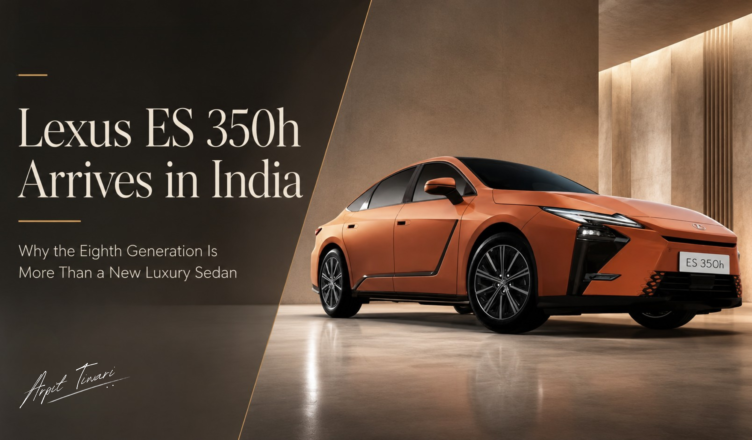
The eighth-generation Lexus ES 350h has officially arrived in India, bringing a larger body, more powerful hybrid system, substantially upgraded technology and a sharper new identity.
But this is not simply another generational update.
It is a carefully considered example of how an established luxury brand can move towards the future without forcing customers to abandon the technology, comfort and ownership confidence they already trust.
The New Lexus ES 350h at a Glance
Lexus ES 350h Exquisite: ₹66.10 lakh
Lexus ES 350h Luxury: ₹71.80 lakh
Powertrain: 2.5-litre self-charging petrol-hybrid
Combined output: Approximately 247 PS
Wheelbase: 2,950 mm
Standard warranty: Eight years or 200,000 kilometres
All prices are ex-showroom, India.
A New Generation, but a Familiar Philosophy
In the luxury automobile industry, progress is often presented as disruption.
Electric must replace hybrid. Touchscreens must replace physical controls. New-generation products must look completely unrelated to the models they succeed.
But intelligent product leadership is rarely about forcing change.
It is about understanding how much change customers are ready to embrace—and then creating a confident bridge between familiarity and the future.
That is what makes the arrival of the eighth-generation Lexus ES 350h strategically important.
The new ES does not abandon the qualities that made the outgoing ES 300h successful. Instead, it strengthens them with greater performance, more space, improved technology and a far more expressive design.
The Lexus ES 350h is not attempting to disrupt its own identity. It is evolving it with greater confidence.
From ES 300h to ES 350h: What Has Changed?
The outgoing seventh-generation Lexus ES 300h was not an unsuccessful product waiting to be reinvented.
It was Lexus India’s first locally produced model and became one of the brand’s most important offerings in the country.
Replacing a successful product requires discipline.
Change too little, and the new generation risks feeling irrelevant.
Change too much, and the qualities that created customer loyalty may disappear.
The eighth-generation ES attempts to preserve Lexus’ traditional strengths—quietness, comfort, craftsmanship and reliability—while making a decisive move forward in design, size, performance and technology.
Old Lexus ES 300h vs New Lexus ES 350h
| Specification | Outgoing ES 300h | New ES 350h | Change |
|---|---|---|---|
| Starting price | ₹62.65 lakh | ₹66.10 lakh | ₹3.45 lakh higher |
| Top variant price | ₹68.23 lakh | ₹71.80 lakh | ₹3.57 lakh higher |
| Length | 4,975 mm | Approx. 5,140 mm | 165 mm longer |
| Width | 1,865 mm | 1,920 mm | 55 mm wider |
| Height | 1,445 mm | Approx. 1,555 mm | 110 mm taller |
| Wheelbase | 2,870 mm | 2,950 mm | 80 mm longer |
| Combined output | 218 PS | Approx. 247 PS | Around 13% higher |
The entry price has increased by approximately 5.5%, but the new model offers measurable improvements in nearly every major area.
It is longer, wider, taller and more powerful. It also carries substantially more technology and a noticeably stronger road presence.
That is an important commercial balance.
Customers are not simply being asked to pay more for a newer badge. Lexus has added value in areas that directly influence desirability, comfort and long-term ownership experience.
A Bigger Car—But Not Merely for the Sake of Size
The new Lexus ES is approximately 165 mm longer than the outgoing model, while its wheelbase has increased by 80 mm.
These are not merely styling statistics.
They reflect the growing responsibility of the ES within Lexus’ sedan portfolio.
At approximately 5.14 metres in length, the new model has a noticeably stronger executive presence. Its wider and taller body creates a more substantial stance, while the longer wheelbase should improve passenger space—particularly in the rear cabin.
That matters in India.
Although many luxury-car customers enjoy driving themselves, the executive-sedan segment continues to attract owners who spend significant time in the rear seat.
Legroom, ride quality, cabin isolation, seat comfort and ease of entry remain central to the buying decision.
The ES 350h must therefore perform two roles successfully.
It must feel contemporary and engaging from the driver’s seat while continuing to deliver the calm, refined experience expected by chauffeur-driven customers.
Lexus Has Given the ES a Much Bolder Identity
The eighth-generation ES represents a significant departure from the traditional Lexus spindle-grille design.
Lexus describes the new philosophy as “Provocative Simplicity”, with inspiration drawn from the LF-ZC concept.
The front is sharper and more technical, supported by distinctive twin L-shaped lighting signatures. A coupe-inspired roofline creates a more dynamic silhouette, while flush-fitting door handles give the body a cleaner, more contemporary appearance.
At the rear, a full-width lighting treatment and illuminated Lexus lettering strengthen its visual identity.
This is more than a facelift.
It is a strategic repositioning.
The outgoing ES was elegant but intentionally conservative. The new model appears designed to attract attention without becoming excessive.
That is a difficult balance in the luxury segment.
A premium sedan must look contemporary enough to remain desirable, but restrained enough to age gracefully.
The new ES looks less like a cautious update and more like a statement that Lexus wants its executive sedan to be noticed.
Technology Moves to the Centre of the Experience
The cabin has undergone an equally important transformation.
A 14-inch touchscreen infotainment system now takes centre stage, supported by a 12.3-inch digital instrument cluster.
Depending on the selected variant, key equipment includes:
- Wireless Apple CarPlay and Android Auto
- Dual wireless smartphone chargers
- Powered and ventilated front seats
- Ambient cabin lighting
- Head-up display
- Digital inside rear-view mirror
- Rear sunshades
- Powered boot lid
- Mark Levinson premium audio system
The ES 350h also introduces the latest Lexus Safety System+ 4, supported by eight airbags and an extensive suite of driver-assistance technologies.
However, the real measure of luxury technology is not the number of screens, sensors or features fitted to a vehicle.
It is how naturally those systems become part of the experience.
Customers expect greater digital capability, but they do not want technology to make a car more complicated.
Successful luxury technology should reduce effort. It should improve safety, convenience and comfort without continuously demanding attention.
The real test of the new ES cabin will therefore be whether its digital systems make every journey calmer and more intuitive.
Why the Hybrid Could Be the Most Important ES in India
The fully electric Lexus ES 500e may represent the brand’s electric future, but the ES 350h is likely to remain the more immediately relevant choice for a wider section of Indian luxury-car buyers.
At ₹66.10 lakh, the entry-level ES 350h is ₹23.89 lakh less expensive than the ₹89.99 lakh ES 500e.
That is a substantial difference.
The self-charging hybrid offers electrified mobility without requiring customers to depend on charging infrastructure or change their established refuelling and long-distance travel habits.
For buyers who regularly travel between cities, live in apartments without dedicated charging facilities or simply want improved efficiency without moving to a fully electric vehicle, the ES 350h offers a convincing middle ground.
This does not make the hybrid a rejection of electric mobility.
It makes it a transition product.
And transition products often play a greater role in changing customer behaviour than products positioned only at the technological extreme.
Lexus has consistently followed a multi-pathway approach to electrification, offering hybrids and battery-electric vehicles for different customers rather than prescribing a single solution for everyone.
That is not only an automotive strategy.
It is also a leadership lesson.
Good leaders do not confuse direction with rigidity. They define where the organisation must go while recognising that different customers may require different routes to get there.
More Power Without Abandoning Refinement
The outgoing Lexus ES 300h produced a combined output of 218 PS.
The new ES 350h increases that figure to approximately 247 PS—a gain of around 13%.
That additional performance should provide stronger acceleration and greater confidence during highway driving and overtaking.
However, the ES has never positioned itself as an aggressive performance sedan.
Its appeal lies in delivering smooth, quiet and efficient progress.
The additional power matters not because it transforms the ES into a sports sedan, but because it allows the larger car to deliver stronger performance without compromising its relaxed character.
That approach fits the identity of the model.
Luxury does not always need to feel dramatic.
Sometimes, the absence of effort is what feels most premium.
Ownership Confidence Is Becoming Part of the Product
Specifications create interest.
Confidence completes the purchase.
From 1 April 2026, Lexus India expanded its standard vehicle warranty to eight years or 200,000 kilometres, at no additional cost, subject to applicable terms and conditions.
For a luxury hybrid customer, this is more than an after-sales benefit.
It represents institutional confidence in the vehicle’s engineering, durability and long-term ownership proposition.
Premium customers are no longer evaluating only design, performance and brand prestige.
They are also considering:
- Service quality
- Reliability
- Downtime risk
- Long-term maintenance support
- Warranty protection
- Resale confidence
- The manufacturer’s response when something goes wrong
In modern luxury, the ownership experience is not separate from the product.
It is part of the product.
A car may create excitement during a showroom visit, but the service ecosystem determines whether that excitement becomes long-term loyalty.
What the New ES Reveals About India’s Luxury-Car Market
The eighth-generation Lexus ES enters an Indian luxury market where SUVs continue to dominate both attention and sales.
Customers increasingly value road presence, commanding seating positions, practicality and the versatility offered by premium SUVs.
Yet the luxury sedan remains relevant for a specific kind of customer.
A customer who values comfort over visual aggression.
Refinement over theatre.
Efficiency over excess.
And understated authority over unnecessary attention.
The ES has never tried to imitate the personality of its German competitors.
Its proposition has traditionally been different:
Quietness over drama.
Craftsmanship over complexity.
Reliability over aggressive performance positioning.
The new ES 350h strengthens that identity while adding the design, dimensions and technology required to remain relevant in 2026.
It may not be the loudest launch in the segment.
But that may be precisely the point.
The Leadership Lesson: Progress Should Build Confidence, Not Anxiety
The most meaningful lesson from the new Lexus ES is not about horsepower, wheelbase or screen size.
It is about managing change.
Lexus has increased the price, but it has also increased the measurable and perceived value.
It has introduced a fully electric ES, but it has not removed the hybrid alternative.
It has transformed the exterior design while retaining the comfort, quietness and ownership confidence that created the model’s reputation.
That is responsible evolution.
Whether leading a company, developing a product or repositioning an established brand, progress becomes sustainable only when customers understand what they are gaining—not merely what they are being asked to leave behind.
The eighth-generation Lexus ES 350h is therefore more than a new luxury hybrid sedan.
It is an example of how an established brand can move towards the future without disconnecting from the customers who created its success.
The Final Question
In a market increasingly driven by SUVs and electric vehicles, can the new Lexus ES 350h make the luxury sedan desirable again?
Share your perspective in the comments.